OpenClaw. Suite... et fin?

AI industry evolution continues at pace.
Four days ago I published my OpenClaw explainer:
Innovation accelerates faster than governance
If you need proof of the acceleration of time in contemporary IT, consider the ClawdBot Moltbot OpenClaw case study. Here’s the tl;dr: a coder-entrepreneur tinkers with a personal project for a few weeks, open-sources the thing on github and it takes off vertically. Within 72 hours it is massively popular; on its third name after 2 separate trademark ch…
Since then, several developments illustrate the thesis of that post - that governance is rushing to catch up with innovation in real time.
After successive waves of tutorials focused on OpenClaw’s capabilities, security vulnerabilities and unexpected token costs, a fourth wave has emerged: structured risk assessments, graduated authority models, human approval gates and constrained execution policies. Think of this as a community offering of governance principles and best practices.
In the corporate IT market, Big Software is taking steps down the agentic path. For example, Microsoft, Google, Amazon, IBM, Salesforce and many others already offer orchestration platforms to enable, as Google puts it, building, scaling and governing enterprise grade AI agents. Microsoft has announced its intention to turn Windows into an agentic operating system. Tasks that are done today by the user or triggered by an interaction with an embedded LLM chatbot will be transferred to autonomous agents. In developmental builds of Windows some experimental functions can be enabled creating “agent connectors” and “agent workspaces” which essentially grant access and execution permissions over the user’s applications, files and file system and allow an autonomous agent to act on behalf of the user. Agent 365 has been introduced as the control plane for AI agents, which is significant because when the agent is treated more like a user than an application questions of governance, ethics, privacy and liability are inevitable. Enterprise and corporate customers have a level of sophistication as well as tools, organisational functions and skills to manage agents within their organisation.
However private individuals do not have those tools, and even if they did they might not have the time or the skills to administer agentic AI on their hardware. The implication is that the rise of agentic AI will be accompanied over time by a worrying further transfer of power to actors like Microsoft, Apple and Google.
Meanwhile, OpenClaw as a project has evolved in a familiar way but at unfamiliar speed.
Peter Steinberger gave a wide-ranging interview to Lex Fridman, discussing inter alia the potential next steps for OpenClaw. Steinberger had been discussing with “all the big labs” of which Meta and OpenAI “were the most interesting” last Thursday. He explained that the best way to accelerate the timeline of the project and boost the adoption of AI would be to partner with a “big company” but not in a way that would “make [OpenClaw] theirs.” It seemed from the interview that a rapprochement with Anthropic was off the table but he was expecting to conclude a deal with Mark (Zuckerberg) or Sam (Altman).
Two days later, Sam Altman posted this on X:
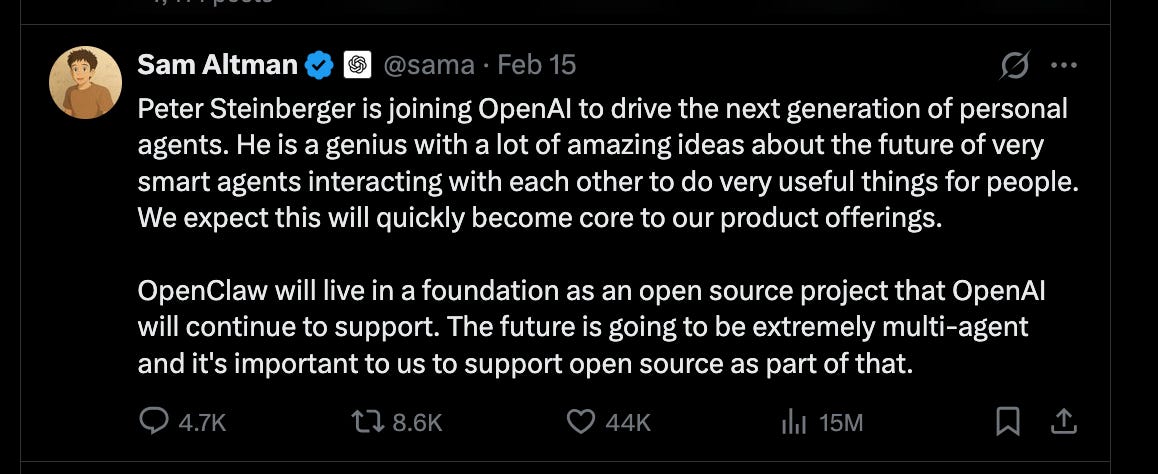
Altman’s post is clear. He is acquiring Peter Steinberger, not OpenClaw which, for obvious reasons, will be encapsulated in a foundation supported by OpenAI. Altman achieves several objectives simultaneously: outbidding his rivals for exclusive access to Peter Steinberger for the time being while attaching the hottest open source project of all time and the most exciting project currently in the AI space to his ChatGPT juggernaut.
There were two immediate topics of speculation: firstly the VC-gossip-disguised-as-strategic-question of how much OpenClaw is worth to OpenAI (potentially up to a billion dollars)? and secondly, the corporate governance question of whether OpenAI could cause the demise of OpenClaw?
Those of us who participated during the 1990s transformation from telephone to internet technologies and services recognise the pattern. The first phase of the OpenClaw story was technological disruption combined with a form of regulatory arbitrage. The second phase is institutional absorption. What begins as a garage experiment rapidly becomes a community project, then an ecosystem and finally a billion-dollar strategic asset in the contest between the institutional players with the deepest pockets. And when capital cannot outright acquire, it acqui-hires. The speed is unprecedented; the pattern is not.
OpenClaw will almost certainly survive institutionalisation in some form. Foundations have in several instances proved capable stewards of open-source projects, channelling the somewhat anarchic life-force that animates their communities. Those communities can also be ideologically fickle, which is a risk. What remains to be seen is whether Steinberger can sustain OpenClaw’s creative energy while now steering it along a path compatible with OpenAI’s roadmap rather than independently. That tension between community-driven innovation and platform-aligned governance is itself another familiar stage in the lifecycle of transformative software.
Suite… mais pas fin.